When the Scan Never Stops
Understanding Sympathetic Dominance Through the Lens of LiDAR — and Why We’re Starving for Stillness
Understanding Sympathetic Dominance Through the Lens of LiDAR — and Why We’re Starving for Stillness
For years, my mind didn’t shut off.
Not in some dramatic way. Just constant.
Always reading. Always checking. Always running the next scenario.
And if you’ve never lived it, it’s hard to explain—because from the outside it can look like discipline. Like ambition. Like, “He’s just wired that way.”
But inside, it feels like your system never gets permission to exhale.
Most people have heard “fight or flight,” but few understand what it looks like in real life. Your nervous system isn’t symbolic, it’s a real system in the body, firing signals constantly, designed to keep you safe.
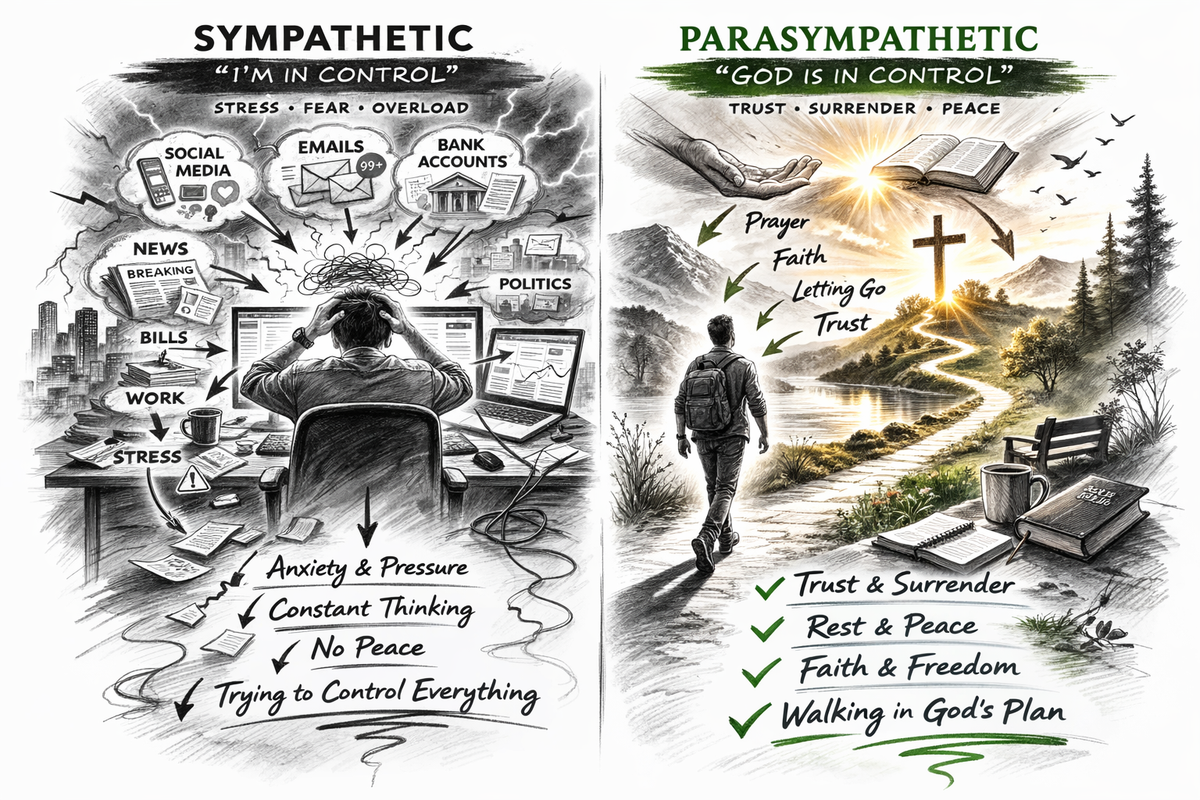
At the most basic level, we move between two modes:
- Sympathetic: scanning, reacting, mobilizing
- Parasympathetic: processing, restoring, integrating
Both are by design.
The issue isn’t that you scan. The issue is when you can’t stop scanning.
“For God gave us a spirit not of fear but of power and love and self-control.” - 2 Timothy 1:7
That verse matters here, because sympathetic dominance can feel like fear is the default setting—even when nothing is “wrong” on paper.
What the Sympathetic System Actually Does
The sympathetic system is the body’s “ready” mode.
It increases heart rate, sharpens focus, and prepares you to act. If something real happens, like a car swerving into your lane, you want that system online.
But it doesn’t only respond to obvious danger. It responds to inputs like:
- emails
- deadlines
- financial pressure
- relationship tension
- noise and overstimulation
- social comparison
- old trauma
- even your own thoughts
And here’s one of the biggest misunderstandings:
The body often can’t tell the difference between a real threat and a perceived one.
It just registers incoming data and adjusts toward “ready.”
That’s why you can be sitting still and still feel like you’re bracing for something to happen or fall apart.
“Anxiety in a man’s heart weighs him down…” - Proverbs 12:25
It weighs you down because it’s not just a thought, it’s a whole-body state.
Why LiDAR Is a Great Picture of This
LiDAR fires millions of points outward to map an environment with precision. It captures tiny details, micro-changes, and subtle shifts.
That’s exactly how a nervous system works when it’s in scanning mode.
Every second, your body is picking up:
- tone of voice
- facial expressions
- body language
- tension in a room
- sensory overload
- uncertainty about the future
- internal emotion
- memories that show up uninvited
- physical sensations you can’t always explain.
Millions of “data points,” nonstop.
LiDAR helps you see the problem clearly:
No system can scan forever without stopping to process.
At some point, the information has to be downloaded, organized, and integrated, otherwise the system fills up. And when we stay constantly connected to the noise, we never fully download or process the overload of information.
And when it fills up, it doesn’t always show up as a breakdown in public.
Sometimes it shows up as a breakdown in private.
What It Looks Like When You Live There Too Long
For a long time, my internal scanner stayed on high resolution.
On the outside, it could look like I was productive, responsible, and dependable.
On the inside, it was constant mental motion.
I wasn’t just thinking, I was tracking.
· Tracking people.
· Tracking outcomes.
· Tracking problems before they happened.
Thoughts piled up like unprocessed files.
Sleep wasn’t truly restorative.
Stillness didn’t feel calming, it felt unfamiliar.
And this matters:
When you’ve lived in scan mode long enough, calm can feel strange at first.
Not because calm is bad, but because your body isn’t used to it.
“Be still, and know that I am God.” - Psalm 46:10
That verse is simple, but if you’ve been living in high alert, “be still” isn’t a pleasant idea. It’s a real challenge. Sometimes it even feels unsafe at first.
Breakers Trip for a Reason
In an electrical system, breakers don’t trip to punish you. They trip to prevent damage.
The body is similar. When the system is overloaded, it starts protecting itself in ways that can look like:
- anxiety
- panic
- irritability
- emotional numbness
- burnout
- shutting down
These aren’t always signs of weakness.
A lot of the time they’re signs the system is saying:
“We’ve taken in too much. We haven’t processed any of it. Something has to give.”
And if you’re like me, you don’t always slow down when the breaker starts warning you.
You push. You handle it. You “keep it moving.”
Until you can’t.
When the System Can’t Power Down, We Reach for Relief
This is where I want to be direct, because it matters.
When your nervous system stays sympathetic-dominant long enough, your body starts craving regulation, anything that brings the intensity down, even for a moment.
That’s where the likelihood goes up for behavioral addictions and substance abuse.
Not because you’re “bad.”
Not because you “lack willpower.”
But because your system is overloaded and looking for a lever.
So, you reach for things that work fast:
- scrolling
- porn
- gambling
- food
- shopping
- work and productivity (yes, even that can become a form of escape)
- alcohol
- pills
- anything that turns the volume down quickly.
Here’s the honest truth:
Addiction is often a nervous-system strategy before it becomes a life problem.
It starts as relief.
Then it becomes a pattern.
Then the pattern becomes a prison.
My definition of Addiction – “Addiction is a learned escape that becomes a biological dependence, reinforced by emotional pain and generational patterns until the person no longer controls the coping mechanism. The coping mechanism controls them.”
And I can say that without giving you the details of my story:
I wasn’t chasing “fun.” I was chasing quiet.
I wanted the scanning to stop. I wanted my insides to be calm.
“Come to me, all who labor and are heavy laden, and I will give you rest.” - Matthew 11:28
Rest isn’t just physical. Sometimes it’s internal.
Sometimes it’s the kind of rest you don’t know how to access anymore.
The 200-Year Reality Check
Just think in the real world:
- phones buzzing
- notifications flashing
- breaking news every few minutes
- everyone’s opinion available instantly
Before you have really even started your day, your brain is already consuming data.
Two hundred years ago, your inputs were limited:
- family
- work
- church
- a few neighbors
- local community
You didn’t wake up to the opinions of ten thousand strangers.
You didn’t carry the weight of the whole world in your pocket.
Today, we process more information before breakfast than people back then could’ve encountered in a lifetime.
That’s not exaggeration, that’s reality.
And here’s the key point that makes it even heavier:
Even back then, even with limited inputs, anxiety and unrest of the mind were still real enough that Scripture addressed it repeatedly.
And those warnings weren’t written two hundred years ago. They were written thousands of years ago.
So, if the Bible addressed anxiety in a simpler world, what do we think nonstop input is doing to people now?
And then we wonder why we have a crisis.
“Do not be anxious about anything…” - Philippians 4:6–7
“Cast all your anxiety on him because he cares for you.” - 1 Peter 5:7
But I want to bring this full circle, because this is where we’ve drifted.
In simpler times, people still had problems.
They still had fear.
They still had uncertainty.
But there was a basic understanding built into everyday life:
They were not in control. God was.
- They worked.
- They planned.
- They did what they could.
But they also lived with a dependence that a lot of us have forgotten.
And when you live like everything depends on you, your money, your plan, your performance, your reputation, your outcomes, your nervous system stays on high alert. Of course it does.
Because your body is following your beliefs.
If you believe it all rests on your shoulders, your system will keep scanning like it’s your job to hold the world together.
“Trust in the LORD with all your heart, and do not lean on your own understanding.” - Proverbs 3:5–6
That’s not just spiritual advice.
That’s nervous-system truth.
Trust is regulating.
Surrender is stabilizing.
And yes, it takes practice, because letting go feels risky when you’ve spent years gripping the wheel.
Trauma Turns Up the Resolution
If you’ve lived through trauma, especially early in life, your internal scanner becomes more sensitive.
- You pick up tone shifts others miss.
- You read tension before anyone speaks.
- You notice subtle changes in expression or posture.
That’s not weakness. That’s adaptation. It protected you in one season.
But if you never get to safely process what you carry, that sensitivity turns into hypervigilance—and hypervigilance is exhausting.
“He heals the brokenhearted and binds up their wounds.” - Psalm 147:3
God doesn’t shame wounds. He heals them.
Why You Can’t Heal in Sympathetic Dominance
When you’re in sympathetic dominance:
- threat detection increases
- logic and long-term thinking narrow
- digestion slows
- emotional regulation becomes harder
- the body stays “ready”
You can function, but it’s hard to integrate.
You can survive, but it’s hard to heal.
And spiritually, constant scanning makes it hard to hear clearly.
That’s why “be still” is such a big deal.
“Be still, and know that I am God.” - Psalm 46:10
“In returning and rest you shall be saved; in quietness and in trust shall be your strength.” - Isaiah 30:15
That’s not soft language.
That’s a blueprint for strength.
This Isn’t About Shame. It’s About a Shift.
If this is you, I want to say it plainly:
You’re not broken.
You’re overloaded.
Sympathetic dominance often begins as protection.
It keeps you alert.
It keeps you functioning.
It keeps you safe.
But what protects you in one season can trap you in the next.
Healing starts when you learn to shift:
- Scan.
- Process.
- Scan.
- Process.
Then:
- Collect.
- Render.
- Rest.
And I’ll add this, because it’s as “me” as it gets:
I had to learn that peace isn’t something you earn by fixing everything.
Peace is something you return to by remembering who’s actually in control.
What Comes Next
Once the scanning slows down, the real work begins:
- The data downloads.
- The noise gets cleaned.
- The points align.
- Clarity forms.
That’s parasympathetic.
That’s integration.
That’s healing.
Next post, I’m going to talk about how to access parasympathetic mode, and why it can feel uncomfortable at first.
For now, ask yourself:
- When was the last time you stopped scanning?
- Not numbing.
- Not scrolling.
- Not distracting.
Real processing.
Because no system can run in scan mode forever.
It’s better to power down intentionally than to wait until the breaker trips.
Because healing requires stillness, not speed.