Trauma, Triggers, and What Happens When We Never Properly Process What We Lived Through
Trauma is not just what happened to us. It is what happened inside of us when life hit before we had the maturity, support, or tools to properly process it. This post explores trauma, triggers, addiction cycles, and how Scripture points us toward truth, healing, and peace.
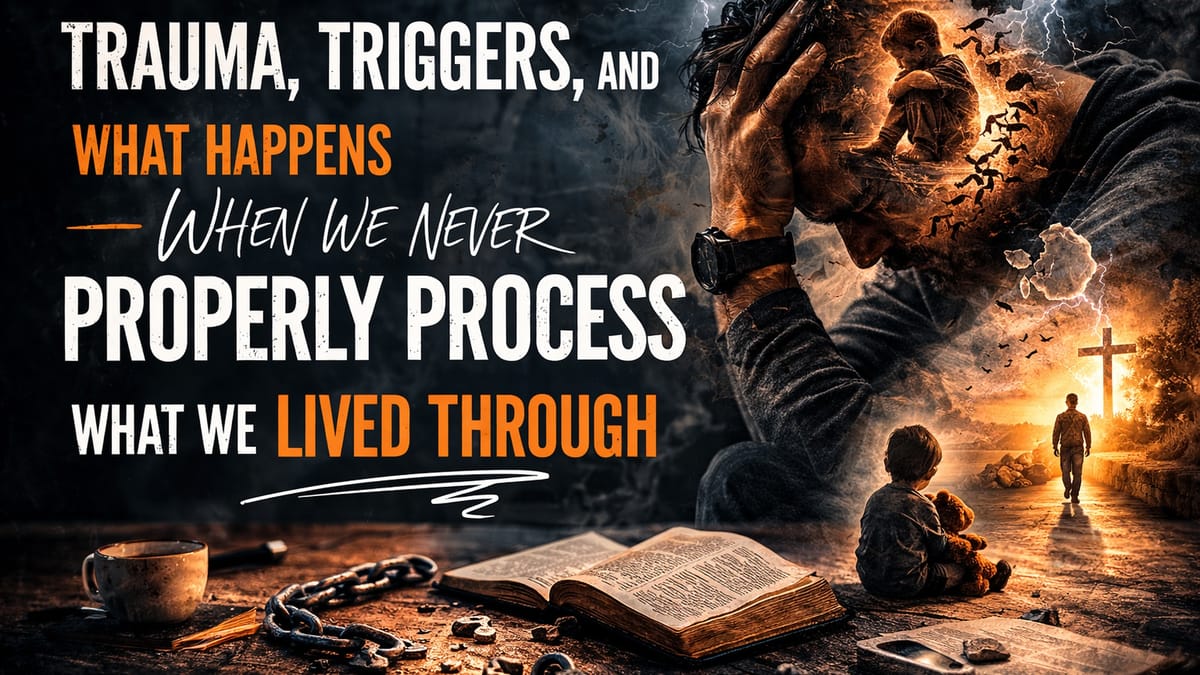
Trauma!
Let’s talk about trauma.
Not the watered-down version of the word. Not the version that gets used so often it starts to lose meaning. And not the version where every difficult moment gets labeled the same.
I mean trauma for what it actually is.
Trauma is what happens when life hits you with something you were never prepared to process. Sometimes it’s one event. Sometimes it’s a collection of events. Either way, it leaves an imprint when your mind and body don’t know what to do with what just happened.
That’s the simplest way I know how to say it.
Because trauma is not just “something bad happened.” Bad things happen in life.
Trauma happens when something hits you beyond your understanding, beyond your maturity, beyond your support system, or beyond what your mind and body were ready to handle in that moment.
Some trauma comes through one major moment. Some comes through repeated exposure. Some comes through chaos in the home. Some through fear. Some through abandonment. Some through humiliation. Some through violence. And some through being exposed to things far too early, things your mind had no business trying to process at that age.
And that matters. A lot.
Because if something hits you before you have the knowledge, maturity, language, safety, or support to process it, it rarely passes through you cleanly. It tends to stay. It leaves a mark. An imprint.
And if it is never properly dealt with, time alone does not make it disappear.
It usually shows back up in patterns.
“The Lord is near to the brokenhearted and saves the crushed in spirit.”
Psalm 34:18
God has never minimized what crushes a person internally.
Background Matters More Than We Realize
Two people can live through something similar and walk away carrying very different outcomes.
That doesn’t mean one is weak and the other strong. It doesn’t mean one is dramatic and the other resilient.
A lot of times, it simply means background matters.
· How you were raised matters.
· What you were exposed to matters.
· What safety looked like matters.
· Whether you had guidance matters.
· Whether you lived in peace or chaos matters.
· Whether anyone taught you how to process fear, pain, conflict, and emotion matters.
A child who grows up in constant yelling may become an adult who shuts down at the slightest tone shift, not because they’re “overly sensitive,” but because their body learned early that raised voices meant threat.
A kid who grew up having to become the emotional adult may become an adult who struggles to rest, because responsibility became their earliest form of survival.
This is why some people are already carrying a quiet stack of unresolved things before the next hard moment ever hits.
“Above all else, guard your heart, for everything you do flows from it.”
Proverbs 4:23
This isn’t just about morality. It’s about formation. What gets inside the heart shapes what comes out of a life.
When Trauma Isn’t Processed, It Becomes a Lens
When trauma isn’t processed, it doesn’t just become a memory. It often becomes a lens.
It shapes:
- how you interpret life
- how you read people
- how quickly you feel threatened
- how easily you get overwhelmed
- how you respond under pressure
- how much rest your body even allows you to feel
- how unfamiliar peace starts to feel
The event may be long over, but the imprint remains.
You hear it in statements like:
- “I know I should be over this by now.”
- “I don’t know why I reacted that hard.”
- “I don’t even know why this bothers me.”
- “I don’t know why I keep going back to the same things.”
Often the issue isn’t “bad behavior.”
It’s unresolved pain, unresolved fear, and an internal system that never truly learned how to settle after what it lived through.
“When I kept silent, my bones wasted away through my groaning all day long.”
Psalm 32:3
Silence doesn’t heal what is unresolved. It buries it.
What Triggers Really Are
Triggers are widely misunderstood.
A trigger is not weakness. A trigger is not softness. A trigger is not someone looking for an excuse.
A trigger is when something in the present touches something unresolved from the past.
It can be:
- a tone of voice
- a smell
- a look
- a place
- a kind of conflict
- a form of rejection
- a memory
- a visual
- a conversation
- a sensation
Suddenly, your response is no longer about the moment in front of you it’s about what this moment reminds your body of.
That’s why some reactions feel bigger than the situation. The trigger isn’t the whole problem. It’s the access point.
“Be sober-minded; be watchful.”
1 Peter 5:8
Not all vigilance is spiritual. Some people are vigilant because their nervous system has never felt safe enough to rest.
What Happens Mentally When Triggers Hit
When unresolved trauma gets triggered, it can shift a person internally, fast.
Your:
- thoughts can speed up
- emotions can spike
- body can tense
- perspective can narrow
- sense of threat can elevate
- tolerance can drop
Some people get angry quickly. Some shut down. Some spiral mentally. Some isolate. Some reach for whatever numbs or distracts.
Triggers don’t just affect emotions, they can affect your whole mental posture.
They can:
- distort perspective
- amplify fear
- pull you into old patterns
- make safe moments feel unsafe
- make small moments feel massive
- make peace feel unreachable
Over time, a person can start living in anticipation of the next internal hit.
And that is exhausting.
“We take captive every thought to make it obedient to Christ.”
2 Corinthians 10:5
Not every thought deserves agreement especially thoughts shaped by old wounds.
How Addiction Cycles Feed on Untreated Trauma
This part is personal for me.
As someone living in remission from substance abuse disorder and bipolar disorder, I know firsthand how untreated trauma and addictive patterns can feed each other.
Not every addiction comes from trauma, and not every trauma response becomes addiction but untreated trauma gives addiction fertile ground.
Why?
Because when something inside you is unresolved, you often start looking for relief, anything that shifts your internal state quickly.
And when the brain finds something that changes your state fast, it remembers.
That’s how cycles start:
Pain → Trigger → Craving relief → Temporary escape → Shame → Repeat
This loop can show up through:
- substances
- pornography
- food
- scrolling
- work
- chaos
- relationships
- anything that helps you escape what you don’t know how to face
Destructive behavior isn’t excusable, but it is understandable.
If you only attack the behavior and never the wound, the symptom may quiet for a season, but the source stays untouched.
“Everything is permissible for me, but I will not be mastered by anything.”
1 Corinthians 6:12
Unresolved trauma makes people vulnerable to mastery.
When Trauma Is a Collection of Events
Trauma isn’t always one massive moment.
Sometimes it’s:
- growing up in instability
- constant conflict
- repeated rejection
- repeated fear
- repeated emotional chaos
- repeated violation of trust
- environments where your body never exhaled
Over time, you start building a life around survival without realizing it.
· Hypervigilance feels normal.
· Restlessness feels normal.
· Overthinking feels normal.
· Instability feels normal.
· Compulsive coping feels normal.
· Always being “on” feels normal.
But familiar doesn’t mean healthy.
“Come to me, all who labor and are heavy laden, and I will give you rest.”
Matthew 11:28
He wasn’t speaking only to sin. He was speaking to burden.
God Had Language for This Long Before We Did
Scripture may not use the word “trauma,” but God consistently speaks to what fear, shame, hiding, burden, and unresolved pain do to a person.
He speaks to:
- the weary
- the burdened
- the brokenhearted
- the fearful
- the anxious
- the overwhelmed
- those carrying what they were never meant to carry alone
God knew what repeated burden does to a heart long before psychology named it.
That’s why Scripture calls us to:
- surrender
- renewal
- rest
- truth
- peace
- confession
- prayer
- guarding the heart
“Cast all your anxiety on him because he cares for you.”
1 Peter 5:7
“Be transformed by the renewal of your mind.”
Romans 12:2
“You keep him in perfect peace whose mind is stayed on you.”
Isaiah 26:3
These aren’t shallow encouragements — they’re a map.
What Unprocessed Pain Does Spiritually
Unprocessed pain doesn’t just affect the mind. It affects the spirit.
It can distort:
- trust
- identity
- safety
- relationships
- how you see God
Pain that isn’t processed often turns inward or sideways:
- isolation
- striving
- fear
- bitterness
- hiding
- shame
- hopelessness
Some begin believing they’re too damaged or too broken to change.
But God doesn’t just deal with what we do, He deals with what was done to us, what it did in us, and who we became in the process.
“I was afraid… and I hid myself.”
Genesis 3:10
Fear leads to hiding. Unprocessed pain still does the same.
Healing Starts With Truth
Healing doesn’t begin with pretending it didn’t matter.
Healing begins with truth.
Truth about:
- what happened
- what it did
- what it imprinted
- what patterns were built around it
- what God wants to heal
Many people spend years asking, “What’s wrong with me?”
But the better question is:
· What happened to me?
· What did it teach me?
· What did it wire into me?
· What did I start doing to survive?
· And what does God want to restore?
Because there is a difference between:
- coping and healing
- numbing and peace
- surviving and being restored
“You will know the truth, and the truth will set you free.”
John 8:32
Freedom doesn’t begin with pretending. It begins with truth.
Some people were hit by life long before they had the maturity, covering, or understanding to process what was happening. Some were exposed to things they should never have seen. Some lived in environments that trained them to stay braced and guarded and later the world wonders why they can’t just relax or let things go.
Because trauma leaves an imprint.
And only God fully knows what was written into a person in the moments they didn’t have the strength, language, or understanding to make sense of what they were carrying.
That’s why healing must go deeper than behavior management. It must reach the places where fear entered, where shame settled, where confusion took root, and where survival became the default.
God doesn’t just deal with behavior. He deals with the story beneath it.
Trauma leaves an imprint, but it isn’t the end of your story.
It explains where certain patterns came from, not where you’re headed.
And once you finally understand what happened in you, not just what happened to you, you gain language you’ve never had before. Language that lets you name it, work through it, and eventually change it.
Understanding is the beginning of healing.
Not because everything instantly gets easier, but because you stop fighting invisible battles and start working with clarity instead of confusion.