The Wood He Named
When you've built for a living, you recognize a spec sheet when you read one. God handed Moses dimensions, materials, connections. And one material keeps showing up: acacia. The wood the world would have walked right past.
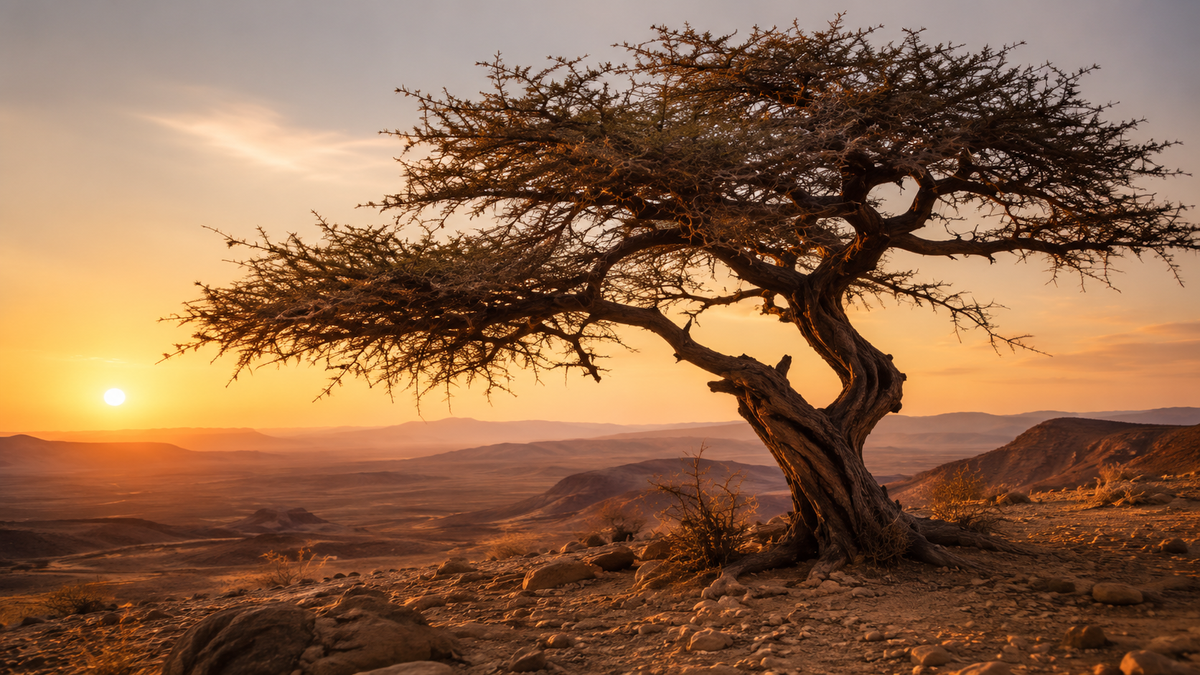
God handed down a complete set of specifications for the place where He would dwell. One material keeps getting named — and it's not the one most people would have noticed.
Reading the Spec Sheet
Coming off the Build It By Design series, I was reading through the Old Testament with construction still clearly on my mind.
While reading Exodus 25–27, I found myself drawn to the detailed instructions God gave for the construction of the Ark and the Tabernacle.
When you've built buildings for a living, you recognize what you're reading.
A design.
A set of specifications.
Dimensions. Materials. Connections. Every detail matters, because the details are what make the structure hold. They're what keep it safe. They're what let it function the way it was designed to.
God didn't simply tell Moses to build Him a place to dwell.
He told him how.
And as I read through those specifications, one material kept showing up.
Not the gold.
Not the curtains.
Not the coverings.
The wood.
Over and over, the same material was named.
Acacia wood.
And that sent me into a deeper study — not only of the material, but of what it might reveal about the God who chose it.
The Master Builder
This is where it begins.
God desired to dwell among His people. So He became the Master Builder.
He didn't leave the design to chance. He didn't tell Israel to gather whatever they could find out there and build whatever seemed appropriate.
He gave them the plans.
The Ark. Acacia. The table. Acacia. The altars, the frames, the crossbars, the poles they'd carry the sacred furnishings by.
Acacia. Acacia. Acacia.
Named. Chosen. Written into the plans by the Master Builder Himself.
That caught my attention.
God didn't only specify what He wanted built. He named the material He intended to use.
What Acacia Actually Is
Acacia is a wilderness tree.
It grows in dry, harsh, unforgiving places. Twisted. Thorned. Unremarkable from the outside. A tree growing in the wasteland. It doesn't have the appearance of a tall, majestic cedar.
It looks more like something that survived than something meant to be admired.
If you were picking timber by looks, you'd choose the cedar. You'd choose the tree that looks like something.
You would not choose this.
But cut into it.
Beneath that rough exterior is wood that's dense, strong, and naturally resistant to decay and insects.
It's wood made to endure.
It can survive the heat.
It can survive the dry ground.
It can survive conditions that would break weaker material down.
The strength goes all the way through.
And that's the material God named for the place where He would dwell.
Not because it was the most impressive in appearance.
Because it could endure the wilderness.
He Wasn't Reading the Outside
That's where this stopped being a study of lumber and became something personal.
Because God doesn't evaluate material the way we do.
We read the outside. The polish. What looks impressive, successful, immediately useful.
But the Master Builder knows what's inside the material.
He knows its strength. He knows what it can withstand. He knows what it can become once it's been placed into His hands.
The acacia grew in barren ground. It carried thorns. Its exterior was rough and unimpressive.
But God knew what was in it.
He knew what it was capable of becoming.
And when He drew up the plans for the place where His presence would dwell, He wrote that wood into the specifications by name.
That's worth sitting with.
The world walks past something because it doesn't look valuable.
The Master Builder sees what it was created to become.
Chosen, but Not Left Untouched
There's another part of the specification that matters.
The acacia was chosen. But it wasn't left in the condition He found it in.
It had to be cut.
Shaped.
Measured.
Joined.
Prepared for a specific purpose.
And then much of it was covered.
The Ark of the Covenant — acacia wood, overlaid with pure gold, inside and out.
The table — acacia wood, covered with gold.
The altar of incense — acacia wood, covered with gold.
The altar of sacrifice — acacia wood, covered with bronze.
God chose the wood. But He didn't leave it rough and unfinished. He prepared it and covered it according to its purpose.
The covering didn't remove the wood.
It didn't pretend the wood had never grown in the wilderness.
It didn't erase where it came from. The wood was still there.
But once it had been chosen, shaped, and covered, it became part of something holy. Something designed to carry His presence. Something built for His purpose.
Maybe that's part of the picture for us, too.
God doesn't choose us because we already look finished.
He doesn't choose us because we already resemble gold.
He chooses what He knows He can shape.
He cuts away what doesn't belong.
He joins us where we're weak.
He prepares us for the weight we'll have to carry.
And then He covers us — not to hide what we are, but to make us useful for what He's called us to become.
The gold didn't make the acacia less real.
The covering revealed its purpose.
And I keep thinking that gold has a New Testament name.
The blood of Christ.
The Thorn
But I wasn't finished looking.
Because acacia is also a thorn-bearing tree.
And throughout Scripture, the thorn carries a meaning that reaches all the way back to the garden.
After the Fall, God told Adam the ground would produce thorns and thistles.
From that point forward, the thorn became an image of the curse — the pain, the resistance, the brokenness that entered creation through sin.
So look again at the material God named.
The wood used to build the Ark of the Covenant — the chest that carried all the items that represented the presence of God among His people — came from a thorn-bearing wilderness tree.
A tree that grew in harsh ground.
A tree marked by the imagery Scripture connects with the curse.
And yet God wrote it into the covenant.
He didn't choose the thorn because the curse was good.
He chose material that had grown in the middle of a fallen world and made it part of the place where He would meet with His people.
Covenant and Crown
Then the story moves forward.
Past the wilderness.
Past the Tabernacle.
Past the Ark.
All the way to the cross.
Scripture doesn't tell us what kind of wood the cross was made from.
But it does tell us what they pressed onto the head of Jesus.
Thorns.
The image of the curse, twisted into a crown and driven down onto the head of the King.
The One who had no sin wore the symbol of what sin had done.
The One who was not under the curse came to bear it.
And this is what God does throughout Scripture.
He doesn't pretend the curse isn't real. He overcomes it.
He doesn't call brokenness good. He redeems what has been broken.
He doesn't let the thorn have the final word.
In the wilderness, wood from a thorn-bearing tree became part of the place where God dwelled among His people.
At Calvary, the symbol of the curse was placed upon the head of the One who came to defeat it.
The thorn was not glorified.
The Savior was.